The Earnings Season That Wasn't What It Looked Like
Every quarter, India's largest public sector banks sit down with analysts, face the press, and announce results that move markets and shape institutional confidence. Q4 FY26 was no different — except in one important respect: the gap between what banks reported and how the market received that reporting was wider than usual.
India's biggest lender, State Bank of India, posted a Rs 19,683.75 crore net profit — a 5.6% year-on-year rise. Bank of Baroda delivered a record Rs 5,616 crore. Indian Overseas Bank's profit surged 43.2%. Punjab National Bank was up 14.4%. On paper, this was a strong quarter for PSU banking.
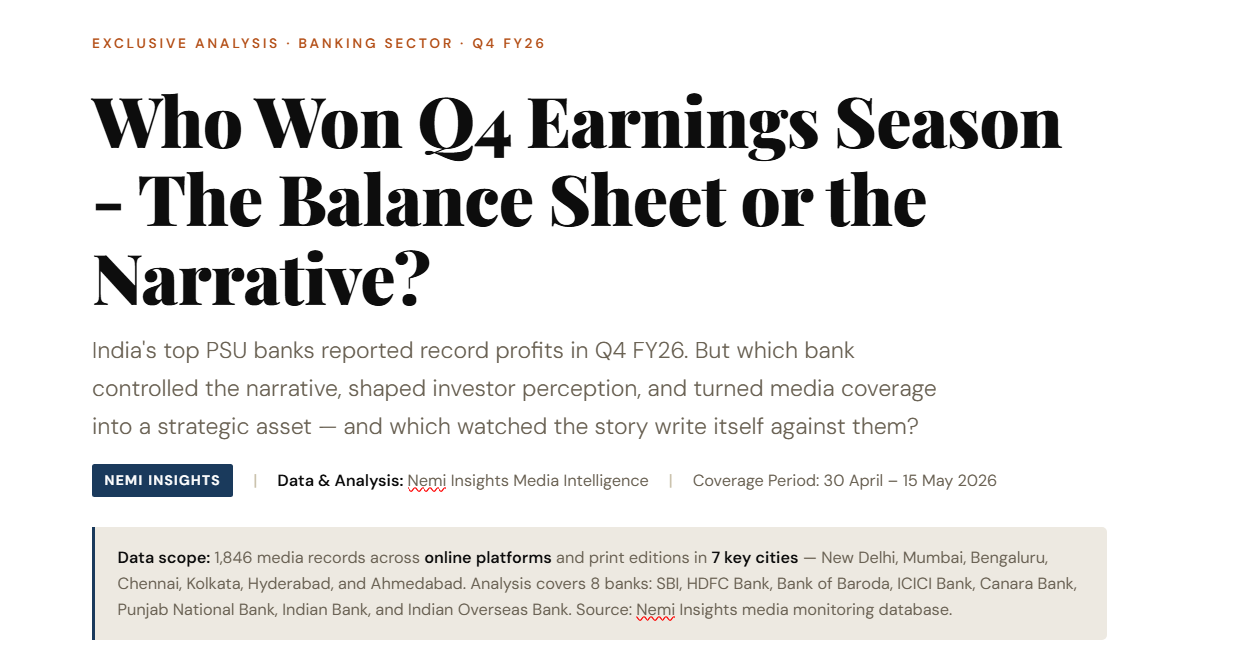
But across 1,846 media records tracked by Nemi Insights between 30 April and 15 May 2026 — spanning online news platforms and print editions across New Delhi, Mumbai, Bengaluru, Chennai, Kolkata, Hyderabad, and Ahmedabad — a starkly different picture emerged. High visibility did not mean positive coverage. And the bank with the smallest media footprint delivered the cleanest narrative.
Of 1,846 media records analysed, SBI commanded 31% of all coverage — but missed analyst estimates and lost 7.4% of its share price on results day. Meanwhile, Indian Overseas Bank, with just 2.2% of media volume, achieved a sentiment net score of +55 — the highest in the peer group — after reporting a 43% profit jump with zero miss-framing in any publication.
Share of Voice: Who Dominated the Conversation
Across the 17-day coverage window, State Bank of India generated 573 of the 1,846 records — nearly one-third of all banking coverage. This is structurally expected for India's largest bank, but volume alone tells an incomplete story.
| Bank | Mentions | SOV % | Online | Print (7 cities) | Volume |
|---|---|---|---|---|---|
| State Bank of India | 573 | 31.0% | 387 | 186 | |
| HDFC Bank | 310 | 16.8% | 230 | 80 | |
| Bank of Baroda | 258 | 14.0% | 170 | 88 | |
| ICICI Bank | 214 | 11.6% | 146 | 68 | |
| Canara Bank | 189 | 10.2% | 117 | 72 | |
| Punjab National Bank | 157 | 8.5% | 109 | 48 | |
| Indian Bank | 105 | 5.7% | 43 | 62 | |
| Indian Overseas Bank | 40 | 2.2% | 17 | 23 |
The volume numbers reveal a counterintuitive truth: the three banks that generated the most positive narratives — Bank of Baroda, Indian Bank, and Indian Overseas Bank — collectively account for only 22% of total media volume. The two banks whose coverage was most negative or contested — SBI and Canara Bank — generated 41.2% combined.
This is the visibility paradox of earnings season. The loudest voice in the room is not always saying what it wants to say.
SBI: The Narrative That Slipped Away
On 8 May 2026, India's largest bank reported its quarterly results. The headline number — Rs 19,683.75 crore net profit, up 5.6% year-on-year — should have been enough to generate positive coverage. But Business Standard's headline that morning read: "SBI Q4FY26 result: Net profit rises 5.6% to ₹19,684 crore, misses estimates."
The miss mattered. According to data compiled by LSEG and reported in the article summary tracked by Nemi Insights, analysts had estimated Rs 20,312 crore — SBI fell short by Rs 628 crore. The miss-framing was immediate and widespread.
Nemi Insights data shows that on 8 May alone, SBI generated 139 media records in a single day — the highest single-day count for any bank in the tracking period. But of SBI's 573 total records, 100 carried negative sentiment signals in their headlines — the highest absolute negative count in the peer group. Republic World's coverage captured the market reaction precisely: "SBI Shares Decline 7.42% After Q4 Result & Dividend Announcement: Check Key Details."
"We continue to maintain our guidance of 13-15 per cent credit growth for FY27."CS Setty, Chairman, State Bank of India — Post-results press conference, 08 May 2026 (Source: ET BFSI, tracked by Nemi Insights)
SBI Chairman CS Setty's forward guidance — 13–15% credit growth for FY27, NSE stake dilution, and a request to revisit the affordable housing definition — offered constructive forward-looking messaging. But this was largely drowned out by the margin compression and treasury loss narrative. Nemi Insights data shows SBI generated 89 market-movement stories in the tracking period — the most of any bank — indicating that share price, rather than strategy, became the dominant media frame.
573 total media records · 31.0% share of voice · 100 negative-headline records · 89 market-movement stories · 135 of 186 print mentions on front page (72.6%) · Net sentiment score: +12.3 · Results announced: 8 May 2026
Bank of Baroda: How to Write a Results Story
While SBI struggled to frame its narrative, Bank of Baroda demonstrated what disciplined earnings communication looks like in practice. On 8 May — the same day as SBI — BoB reported a record Q4 net profit of Rs 5,616 crore, up 11.2% year-on-year.
The Economic Times led with: "Bank of Baroda posts record Q4 profit despite higher provisions." The word "record" did the work. The qualifier "despite higher provisions" was present but subsidiary. This is precisely the framing that investor relations teams spend months engineering.
BoB's MD & CEO Debadatta Chand was proactive. He appeared in a Hindu Business Line video interview saying, "A Healthy Q4 For Bank Of Baroda | Deposit Growth Has Been Very Encouraging." And at the earnings press conference, he announced that BoB had operationalised its primary dealer business from April 1, 2026, and was preparing to enter the pension fund business — giving media a forward-looking business story to carry beyond results day.
The result: 90 earnings result stories and zero negative-market-movement alignment on results day, compared to SBI's 89. BoB's front-page print rate across the seven monitored cities was 63.6% — with 56 of 88 print mentions on page 1. Sentiment net score: +25.1, more than double SBI's.
Record profit framing + asset quality improvement + capital raising announcement (Rs 6,000 crore) + new business lines (primary dealer, pension fund) + forward guidance = a results narrative that gave media four separate constructive story angles simultaneously. This is textbook narrative layering.
What Kind of Coverage Did Each Bank Actually Get?
Not all media mentions are equal. A bank mentioned in a broad market sell-off roundup is not the same as a bank that earns a dedicated earnings analysis with a spokesperson quote. Nemi Insights classified each of the 1,846 records into six story types based on headline and summary content analysis.
The story type data reveals a critical insight: 80% of Indian Overseas Bank's 40 media records were dedicated earnings result stories — the highest earnings-to-total ratio in the entire dataset. For context, only 26% of SBI's 573 records were primary earnings stories; the rest were market-movement pieces, sector roundups, and general co-mentions.
HDFC Bank's coverage was 38% market-movement stories — by far the highest in the group. This is because HDFC did not announce Q4 FY26 earnings in this cycle; its coverage was almost entirely driven by analysts and traders using it as a sector benchmark, not by its own results communication.
Indian Overseas Bank: The Best Story Nobody Heard Loudly Enough
If Q4 FY26 had a narrative winner in terms of quality, it was Indian Overseas Bank. The Chennai-headquartered lender announced on 29 April 2026 that its standalone net profit had surged 43.2% year-on-year to Rs 1,505.45 crore, with consolidated profit rising 45.51% to Rs 1,556.15 crore. Full-year FY26 profit reached Rs 5,208 crore — up 56.16%.
The numbers were unambiguous. NII grew 11.1% to Rs 3,470 crore. Total advances surged 24.1% to Rs 3.10 lakh crore. Net NPA declined to 0.21%. The stock rose 4.06% intraday on the NSE post-results. And MD-CEO Ajay Srivastava gave every publication a clean, quotable headline:
"IOB reported its highest-ever growth, with net profit rising 43 per cent year-on-year to Rs 1,505 crore in Q4FY26 and full-year profit surging 56 per cent to Rs 5,208 crore."Ajay Srivastava, MD-CEO, Indian Overseas Bank — DT Next, 29 April 2026 (Source: Nemi Insights database)
Nemi Insights data shows zero miss-framing records for IOB in the entire tracking period — compared to 61 for SBI and 37 for Canara Bank. IOB's sentiment net score of +55.0 was the highest in the peer group. Among its 40 total records, 26 were positive-headline stories.
IOB also placed a paid advertorial in Business Standard on 1 May 2026 — the only confirmed advertorial placement in the tracked dataset — anchoring its "43.20% profit jump" message directly in one of India's highest-authority financial publications. This is a legitimate and transparent communications strategy, and it worked.
The only gap: reach. With just 40 total records — 2.2% share of voice — IOB's outstanding results did not achieve the amplification they deserved. Its print front-page rate in the seven monitored cities was 47.8%, respectable but below SBI (72.6%) and BoB (63.6%). The story was excellent. The distribution infrastructure was not.
Punjab National Bank's Digital Pivot — A Masterclass in Message Control
PNB reported a solid but not spectacular Q4: net profit up 14.4% to Rs 5,225 crore, but NII declined 3.5% to Rs 10,380 crore and total income fell 1.1%. The NII decline was the kind of number that, left unaddressed, becomes the headline.
PNB's managing director Ashok Chandra did not leave it unaddressed. He chose to redirect the post-results conversation entirely — toward digital banking:
"Digital now account for more than 95% of our transactions, and we aim to have a Rs 2 lakh crore book in FY27 through the digital mode."Ashok Chandra, MD, Punjab National Bank — The Economic Times, 06 May 2026 (Source: Nemi Insights database)
This message — "PNB Sanctions One in Three Loans Digitally" — appeared in six separate editions of The Economic Times, making it the single most-repeated management message in the Nemi Insights tracking dataset for this period. PNB generated 6 earnings-with-spokesperson-quote stories — the highest absolute count in the peer group — despite ranking sixth in total SOV.
The result: a net sentiment score of +33.8 for PNB — the third-highest in the dataset — despite an NII decline that could easily have defined the coverage. This is what effective counter-narrative looks like: not denial, but redirection.
Canara Bank: When the Numbers Write the Story for You
Canara Bank's Q4 FY26 results were genuinely difficult to spin. Standalone net profit declined 9.93% to Rs 5,002.66 crore — or Rs 4,505.57 crore depending on the reporting basis — with NIM contracting to 2.54% from 2.73% year-on-year. Treasury losses were the primary cause.
Business Standard's headline was blunt: "Canara Bank slides as Q4 PAT tanks 10% YoY to Rs 5,003 cr." Analytics Insight: "Profit Falls 10% to Rs. 4,505 Crore as Margins Tighten Despite NPA Drop." The stock fell 3.83% to Rs 129.17 on results day. Quantitative analysts at Smartkarma recommended shorting Canara Bank versus going long on Bank of Baroda.
Canara Bank's interim MD-CEO Hardeep Singh Ahluwalia did speak to The Economic Times, telling the paper that "the bank is trying to protect its net interest margins (NIM) by focusing on core income." This is a defensive posture — an explanation of a problem, not a counter-narrative. It generated one spokesperson-quote story.
| Bank | Positive headlines | Negative headlines | Total records | Net score | Signal |
|---|---|---|---|---|---|
| Indian Overseas Bank | 26 | 4 | 40 | +55.0 | Positive |
| Indian Bank | 50 | 3 | 105 | +44.7 | Positive |
| Punjab National Bank | 72 | 19 | 157 | +33.8 | Positive |
| Bank of Baroda | 93 | 28 | 258 | +25.1 | Positive |
| State Bank of India | 171 | 100 | 573 | +12.3 | Mixed |
| HDFC Bank | 80 | 49 | 310 | +10.0 | Mixed |
| ICICI Bank | 51 | 40 | 214 | +5.1 | Neutral |
| Canara Bank | 35 | 37 | 189 | −1.1 | Negative |
Canara Bank is the only bank in the dataset with a net-negative headline sentiment score (−1.1). It is also the only bank where negative headlines (37) outnumbered positive ones (35). This is a direct consequence of the treasury loss narrative going uncontested in media — no alternative framing, no forward guidance story, no positive metric that editorial desks could use as a lead.
Print Prominence Across 7 Cities: Who Made the Front Page
Nemi Insights tracked print coverage across seven key financial and commercial cities. Of the 627 print records in the filtered dataset, New Delhi led with 113, followed by Mumbai (98), Kolkata (92), Hyderabad (89), Bengaluru (88), Ahmedabad (78), and Chennai (69).
| Bank | Front Page mentions | Total print | Front page % | |
|---|---|---|---|---|
| State Bank of India | 135 | 186 | 72.6% | |
| Bank of Baroda | 56 | 88 | 63.6% | |
| Indian Bank | 32 | 62 | 51.6% | |
| Indian Overseas Bank | 11 | 23 | 47.8% | |
| HDFC Bank | 31 | 80 | 38.8% | |
| Canara Bank | 30 | 72 | 41.7% | |
| ICICI Bank | 28 | 68 | 41.2% | |
| Punjab National Bank | 14 | 48 | 29.2% |
The front page data tells its own story. SBI's 72.6% front-page rate — 135 of 186 print records on page 1 across seven cities — reflects sheer institutional scale. Any SBI results announcement is automatically front-page material for every national financial daily.
Bank of Baroda's 63.6% front-page rate is the more notable achievement. For a bank that generates roughly half of SBI's coverage volume, commanding two-thirds of print coverage on page 1 across Delhi, Mumbai, Kolkata, Hyderabad, Bengaluru, Ahmedabad, and Chennai simultaneously signals that editorial desks treated BoB's results as genuinely significant news — not merely a PSU banking filler.
PNB's 29.2% front-page rate — the lowest in the group — sits in interesting tension with its spokesperson performance. Despite generating the most management quote stories, its print positioning was predominantly inside-page. This suggests PNB's narrative worked better online and in financial media than in mainline newspaper front pages.
The Scorecard: Five Findings That Matter
The most important lesson from Nemi Insights' Q4 FY26 earnings season analysis is a simple one: the bank that wins the earnings season is not always the bank that posts the best numbers — it is the bank whose intended narrative becomes the dominant media narrative. In Q4 FY26, Bank of Baroda understood this. Indian Overseas Bank proved it by accident. And State Bank of India, with all its resources and all its reach, let someone else write its story for it.
Methodology & Data Transparency
Data source: Nemi Insights media intelligence database (Bank_Q4.xlsx). Coverage window: 30 April 2026 to 15 May 2026. Scope: 1,846 records — online platforms (1,219 records) and print editions in New Delhi (113), Mumbai (98), Kolkata (92), Hyderabad (89), Bengaluru (88), Ahmedabad (78), and Chennai (69). Banks covered: State Bank of India, HDFC Bank, Bank of Baroda, ICICI Bank, Canara Bank, Punjab National Bank, Indian Bank, Indian Overseas Bank.
Sentiment classification: Applied to the Headline field using keyword matching (20 positive, 20 negative terms). Story type classification: Applied to combined Headline + Summary fields using rule-based keyword scoring across 6 categories. Front page detection: Page No. field — records where page number starts with "1". Spokesperson detection: Executive title and named executive matching in combined Headline + Summary text. Financial figures: Sourced from article Summary field as reported by publications — not from primary financial statements. All figures are as reported in tracked media coverage.
Limitation: Sentiment my vary due to different perspectives. CCM and MAV fields in the source data are zero; no reach-weighted metrics were computed. All counts are unweighted mentions.
Data & analysis by: Nemi Insights — media intelligence and brand monitoring services.